Are digital wedding invitations tacky? An honest answer
4 min read
On this page
No. A careless invitation is tacky, and it can be careless on paper as easily as on a screen. A wrong name, a missing address, a forwarded image with someone else’s caption still attached: those are what guests remember. The medium is not.
That said, the question is fair, and there are cases where paper is still the better choice. Here is how to tell.
Why people worry
Three reasons, usually.
- Tradition. For a century a wedding invitation meant heavy card, and anything else can feel like a shortcut.
- Looking cheap. A free template with a watermark does look cheap. That is the template’s fault.
- Older relatives. A grandmother who does not use a phone cannot be invited by one.
Only the third is a real problem, and it has a simple answer further down.
What makes any invitation feel proper
Etiquette is about the guest, not the paper. An invitation is proper when:
- it is plainly meant for the person who receives it
- it carries every fact they need: who, when, where, how to reply
- it arrives in good time
- it shows that care was taken
- it matches the wedding: formal for a formal day, easy for an easy one
A film that does all five is a better invitation than a printed card that gets the day of the week wrong.
Where a digital invitation is better
- It arrives. No lost post, no old addresses.
- It reaches everyone on the same day, including the cousin abroad.
- It carries the map. A link or a code to scan beats directions on a card.
- It can be put right. If the venue changes, you send again. You do not reprint.
- It costs far less. More on that below.
- Replies come faster, because the guest is already holding the thing they reply with.
Where paper still wins
- Guests who do not use a phone. Print for them, or better, visit or call.
- A keepsake. Some families keep every wedding card in a box, and a card for the box matters to them.
- The most formal weddings, where the invitation is part of the ceremony of the thing.
- Custom. In many Indian families the card is carried to elders in person, often with sweets. A film does not replace that visit. It follows it.
What each costs
In The Knot’s surveys of American couples, the average spent on invitations and the rest of the wedding paper comes to a little over five hundred dollars, with the invitations themselves between about two hundred and two hundred and fifty. Postage and reprints are extra.
Digital runs from nothing, for a free template you fill in yourself, to a modest fixed price for a film made for you. Ours are priced per film, not per guest, so the hundred-and-fiftieth guest costs the same as the first: see what an invite costs.
The middle path most couples take
Send the film to everyone. Print ten or twenty cards for grandparents, for the people who will frame one, and for the box. You get the reach of one and the keepsake of the other, for a fraction of printing for all.
How to send one so that it feels like an occasion
This is where a digital invitation is won or lost.
- Send it to people, not to a list. For close family and friends, one message each, with a line written for them: “We would love you there.”
- Use their name. “Dear Meera aunty” turns a forward into an invitation.
- Call the elders first. Then send the film as the thing they can show others.
- Send a film, not a flat picture. Something that opens, moves and has music reads as made for the day.
- Mind the hour. Early evening or a weekend morning. Not midnight.
- Make it complete. If a guest has to write back to ask the address, the invitation has failed.
The messages themselves are in the WhatsApp wedding invitation guide.
What about replies?
A film can carry a reply-by date and a code that opens your wedding website or a reply form, and that is what ours does. It does not count the replies for you. If you want a running list of who is coming, pair the film with a wedding website that collects replies, or keep a simple sheet.
The invitation we make
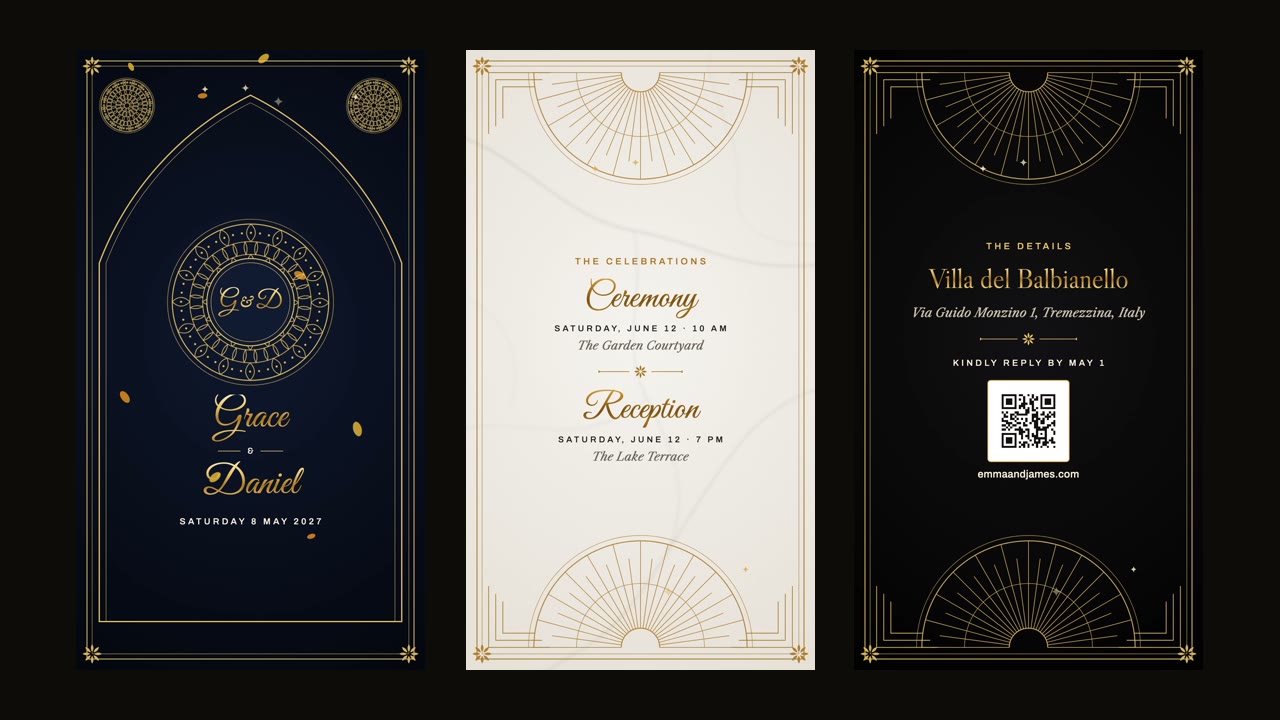
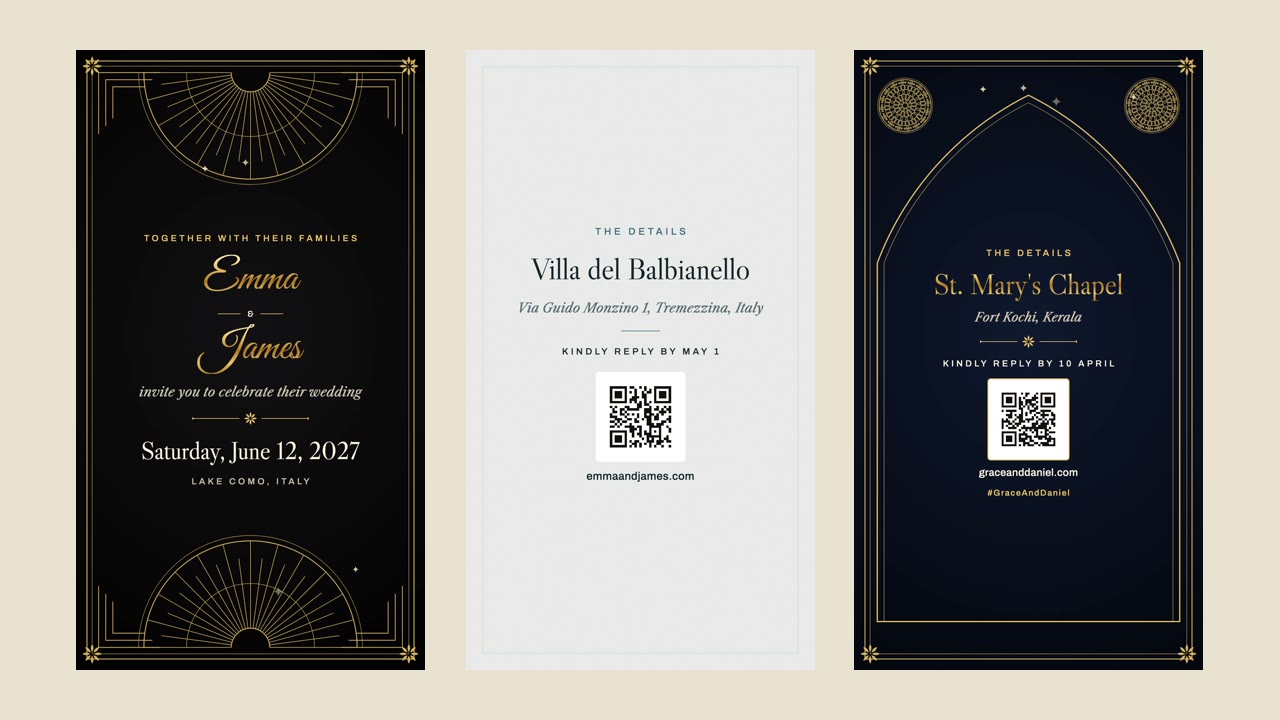
At Starring You Two the invitation is a short vertical film: your names, the date, each function with its day, time and place, the venue and the date to reply by. You fill in a form, choose one of eighteen looks made for different traditions, and watch the film with your own words before you pay. Every word is set as type, so names and dates are spelled exactly as you typed them. It can show the two of you, made from your photos, or a gold monogram with no photos.
What it is not: a design drawn from nothing for you alone. If that is what you want, hire a designer, and expect to pay and wait accordingly.
Quick answers
Are digital wedding invitations acceptable for a formal wedding? Yes, when they are complete, well made and sent personally. Print a few for the guests who would want one.
Is it rude to invite someone by WhatsApp? Not if the message is written for them. A bare forward to a group is the thing to avoid for people close to you.
How much do digital wedding invitations cost? From nothing for a do-it-yourself template to a fixed price for a film made for you. The cost does not rise with the guest list.
Can I send both? Yes, and most couples who print at all now do exactly that.