Hindu wedding invitation wording: card matter in English
5 min read
On this page
- The invocation
- The blessings of the elders
- The hosts and the request
- The two of them, with their families
- The date, the day and the muhurat
- The programme
- The venue
- Those who await you
- The children’s line
- A full sample, with the bride’s parents as hosts
- A sample with the couple as hosts
- A sample in Hindi
- The short form, for a video
- Mistakes worth checking for
- This wording, as a film
- Quick answers
A Hindu wedding card is written to a pattern that has hardly changed in generations. It opens by asking a blessing, it names two families before it names two people, and it invites the guest not to an event but to bless the couple. Once you see the pattern, writing your own takes ten minutes.
Here is each part in order, with wording you can copy, and then the shorter form that suits a video.
The invocation
Every card begins with Lord Ganesha, the remover of obstacles, before a single name appears. The shortest form:
- ॥ श्री गणेशाय नमः ॥
- Shree Ganeshaya Namah (“Salutations to Lord Ganesha”)
Many families print a full verse beneath it. The one seen most:
- Vakratunda Mahakaya, Suryakoti Samaprabha
- Nirvighnam Kuru Me Deva, Sarva Karyeshu Sarvada
It means: O Lord of the curved trunk and mighty body, radiant as ten million suns, make all my undertakings free of obstacles, always.
Another is the mangal shloka: “Mangalam Bhagwan Vishnu, Mangalam Garudadhwaja, Mangalam Pundarikaksha, Mangalaya Tano Hari.”
The blessings of the elders
Grandparents are named first, living or not, because the wedding takes place under their blessing.
- With the blessings of
- Late Shri Ramnath Sharma and Smt. Kamla Devi Sharma
The hosts and the request
The parents of the bride, or of the groom, or both families, invite. The request is for the guest’s presence and blessing.
- Mr. Rajesh Sharma and Mrs. Sunita Sharma
- request the pleasure of your company
- on the auspicious occasion of the wedding of their daughter
The two of them, with their families
The names are joined by “weds”. Each is followed by their parents.
- Ananya
- (Daughter of Mr. Rajesh and Mrs. Sunita Sharma)
- weds
- Rohan
- (Son of Mr. Anil and Mrs. Kavita Mehta)
On traditional cards you will see two prefixes. Chi. before the groom’s name is short for Chiranjeev, “may he live long”. Sau. Kan. before the bride’s is short for Saubhagyakankshini, “she who is wished good fortune”. Use them or not, as your family prefers.
The date, the day and the muhurat
- on Sunday, 14 February 2027
- Muhurat: 7.15 pm
Give the day and the date together, and check one against the other.
The programme
Each function on a line of its own, with its day, time and place.
- Haldi: Friday 12 February, 10 am, at our residence
- Mehndi: Friday 12 February, 4 pm, The Garden Courtyard
- Sangeet: Saturday 13 February, 7 pm, The Lake Terrace
- Baraat: Sunday 14 February, 5 pm
- Wedding: Sunday 14 February, 7.15 pm, The City Palace
- Reception: Sunday 14 February, 8.30 pm onwards
The venue
The full address, and a landmark. Today, a map link or a code to scan as well.
Those who await you
The card closes with the names of the family members who will welcome the guests. Three headings are used:
- With best compliments from, in English cards
- Darshanabhilashi (दर्शनाभिलाषी), “those who long to see you”
- Swagatotsuk (स्वागतोत्सुक), “those eager to welcome you”
Under it go the names of uncles, aunts, brothers and sisters.
The children’s line
Many Hindi cards end with a line in a small child’s voice, lisp and all. It is called the bal manuhar, and it is the most loved line on the card.
- मेरे मामा की शादी में जलूल-जलूल आना।
- “Do come to my uncle’s wedding. You must, you must.”
A full sample, with the bride’s parents as hosts
- ॥ श्री गणेशाय नमः ॥
- With the blessings of Late Shri Ramnath Sharma and Smt. Kamla Devi Sharma
- Mr. Rajesh Sharma and Mrs. Sunita Sharma
- request the pleasure of your company on the auspicious occasion of the wedding of their daughter
- Ananya
- with
- Rohan
- (Son of Mr. Anil and Mrs. Kavita Mehta)
- on Sunday, 14 February 2027
- at The City Palace, Udaipur
- With best compliments from the Sharma family
A sample with the couple as hosts
- ॥ श्री गणेशाय नमः ॥
- With the blessings of our parents
- Ananya Sharma and Rohan Mehta
- invite you to celebrate their wedding
- Sunday, 14 February 2027
- The City Palace, Udaipur
A sample in Hindi
- ॥ श्री गणेशाय नमः ॥
- श्रीमती सुनीता एवं श्री राजेश शर्मा
- अपनी सुपुत्री सौ. कां. अनन्या के शुभ विवाह के पावन अवसर पर
- आपको सपरिवार सादर आमंत्रित करते हैं।
- शुभ विवाह: रविवार, 14 फरवरी 2027
- स्थान: सिटी पैलेस, उदयपुर
The short form, for a video
A film shows one screen at a time, and a screen holds about a dozen words. Keep the order and cut each part to its heart.
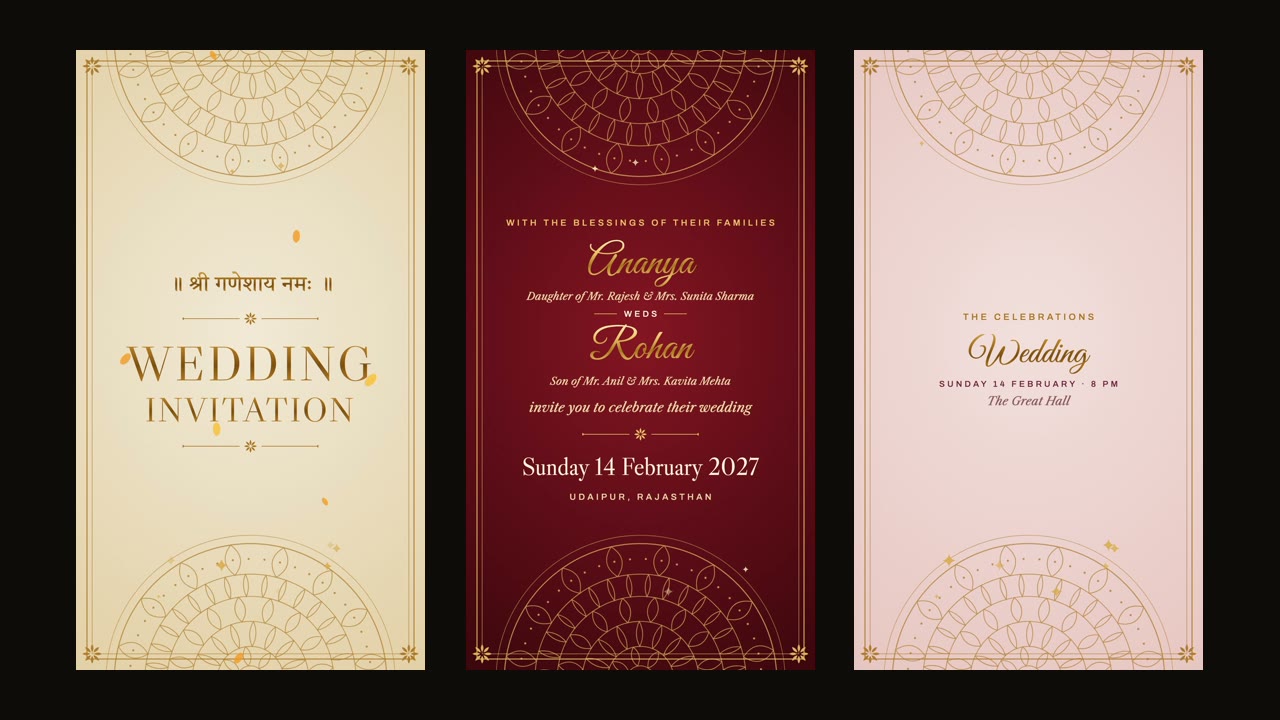
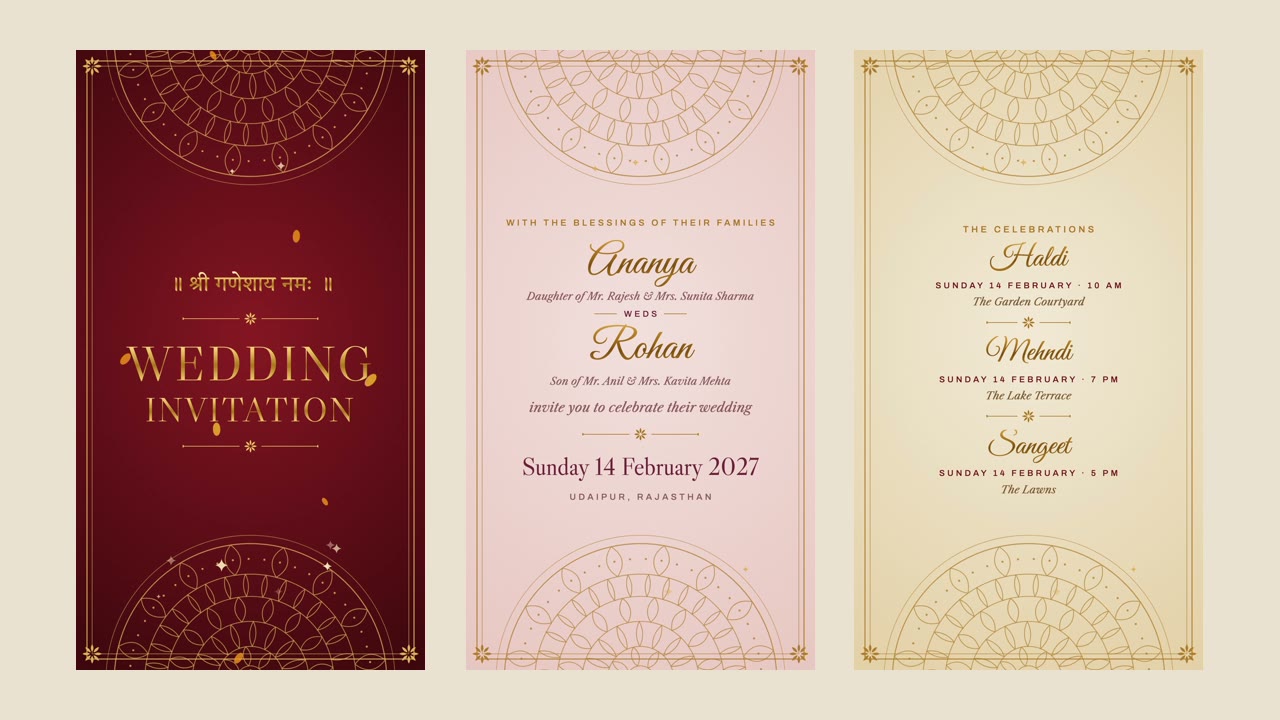
- Screen one: ॥ श्री गणेशाय नमः ॥ and “Wedding Invitation”
- Screen two: “With the blessings of their families”
- Screen three: Ananya, Daughter of Mr. Rajesh and Mrs. Sunita Sharma, weds Rohan, Son of Mr. Anil and Mrs. Kavita Mehta
- Screen four: “invite you to celebrate their wedding. Sunday, 14 February 2027. Udaipur, Rajasthan”
- Screens five and six: the functions, three to a screen
- Screen seven: the venue, the address, the date to reply by, and a code for the map
- Screen eight: “We would be honoured to have you celebrate this day with us”
What to leave out of a film: the long verse, which no one can read in four seconds, and the list of relatives. Keep those for the printed card.
Mistakes worth checking for
- A name spelled two ways. Decide between Sharma and Sharmaa before anything is designed.
- The day and the date not matching. Open the calendar.
- A missing “Late” before the name of an elder who has died, or one put where it does not belong.
- The time. If the muhurat is exact, say so. Guests assume everything starts an hour late.
- No address. “At our residence” needs the address for anyone who has not been there.
This wording, as a film
At Starring You Two the Hindu looks, Palace, Temple, Maharaja, Rani and Blush Lotus, are laid out in exactly this order. The film opens with the invocation in Devanagari, names each of you with your parents, and lists up to six functions with their day, time and place. You type your own wording, in English or in Hindi, and the film plays on the page with it before you pay. It can show the two of you, made from your photos, or carry a gold monogram with no photos. The looks are on the invites page.
For how the whole film is put together, see the Indian wedding invitation video guide.
Quick answers
What is written first on a Hindu wedding card? The invocation to Lord Ganesha: “Shree Ganeshaya Namah”.
What do Chi. and Sau. Kan. mean? Chiranjeev, used for the groom, and Saubhagyakankshini, used for the bride. Both are blessings.
Whose parents invite? By custom each family sends its own card, with its own child named first. A single shared card names both families.
Should the card be in Hindi or English? Whichever your guests read most easily. Many families use the invocation in Sanskrit and the details in English.