Wedding invitation wording examples for every kind of host
5 min read
On this page
- The six parts
- The couple hosting
- Together with their families
- One set of parents hosting
- Both sets of parents hosting
- Divorced parents
- A parent who has died
- Reception only
- A second marriage, or an older couple
- Easy and informal
- Wording for a video invitation
- The lines people hesitate over
- Wording by tradition
- Trying your wording on a film
- Quick answers
Every wedding invitation, however it is dressed, says the same six things in the same order. Once you know the order, the wording stops being a mystery and becomes a matter of filling in names.
Below are the six parts, then wording for each kind of host, then the short form that fits a video.
The six parts
- The host line: who is inviting.
- The request: “request the honour of your presence” or “invite you to celebrate”.
- The names of the two people marrying.
- The date and the time.
- The place.
- What follows, and how to reply.
Two old rules still hold. “The honour of your presence” is for a ceremony in a place of worship; “the pleasure of your company” is for anywhere else. And whoever is named first on the card is the host.
The couple hosting
The commonest today, and the simplest.
- Emma Clarke and James Bennett
- invite you to celebrate their marriage
- Saturday, 12 June 2027, at four o’clock
- Villa del Balbianello, Lake Como
- Dinner and dancing to follow
Together with their families
For when the couple host but both families have helped, which is most weddings. It honours everyone without a list of names.
- Together with their families
- Emma Clarke and James Bennett
- request the pleasure of your company at their wedding
- Saturday, 12 June 2027, at four o’clock
- Villa del Balbianello, Lake Como
One set of parents hosting
The traditional form. The hosts’ child is named by first and middle names only, the other by full name.
- Mr and Mrs Thomas Clarke
- request the honour of your presence
- at the marriage of their daughter
- Emma Rose
- to Mr James Edward Bennett
- Saturday, the twelfth of June 2027, at four o’clock
- St Mary’s Church, Henley
Both sets of parents hosting
- Mr and Mrs Thomas Clarke
- and Mr and Mrs Edward Bennett
- request the pleasure of your company
- at the marriage of their children
- Emma Rose and James Edward
Divorced parents
Each parent has a line of their own, with no “and” between them. A new husband or wife is named beside their own partner.
- Mrs Mary Clarke
- Mr Thomas Clarke
- request the honour of your presence
- at the marriage of their daughter
- Emma Rose
A parent who has died
A parent who has died cannot be a host, but can be named with love. Put them with the name of their child, not in the host line.
- Emma Rose Clarke
- daughter of Mrs Mary Clarke and the late Mr Thomas Clarke
- and James Edward Bennett
- request the pleasure of your company at their wedding
Reception only
For a party after a private ceremony, or held later. Say plainly that the wedding has taken place, so that no one waits for a ceremony.
- Emma and James were married in a private ceremony in May
- Please join them to celebrate
- Saturday, 12 June 2027, from seven in the evening
- The Boathouse, Henley
A second marriage, or an older couple
Keep it in the couple’s own voice and leave the parents out.
- Emma Clarke and James Bennett
- with their children
- ask you to join them as they marry
- Saturday, 12 June 2027
Easy and informal
- We are getting married
- Emma and James
- 12 June 2027, Lake Como
- Come for the ceremony, stay for the dancing
Wording for a video invitation
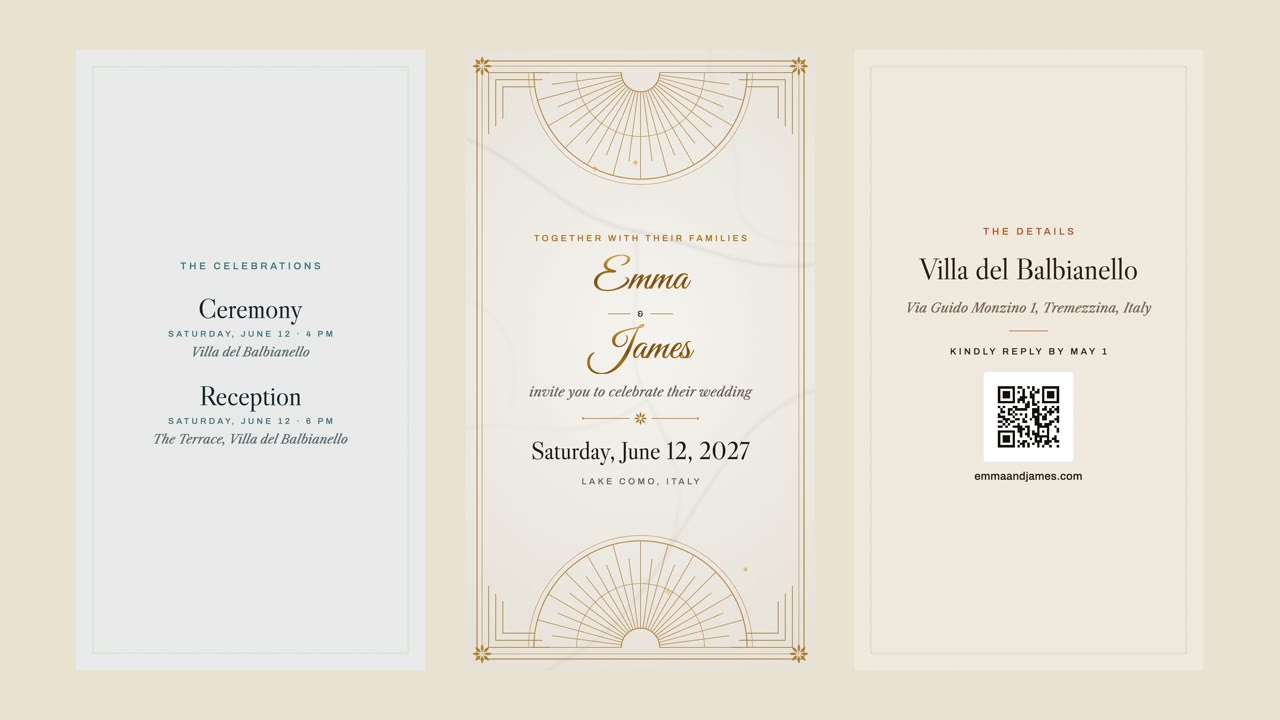
A card is read at a glance. A film is read one screen at a time, and a screen holds about a dozen words comfortably. So the same six parts are split across screens, and each is cut to its shortest true form.
- Screen one, the host line: “Together with their families”
- Screen two, the names: “Emma and James”
- Screen three, the request and the date: “invite you to celebrate their wedding. Saturday, 12 June 2027. Lake Como, Italy”
- Screen four, the events: “Ceremony, 4 pm. Reception, 6 pm”
- Screen five, the details: the venue, the address, “Kindly reply by 1 May”, and a code to scan
- Screen six, the close: “We would be honoured to have you with us”
Three things change on screen. Write the date in figures, since “the twelfth of June” is slow to read on a phone. Drop titles and middle names unless the family wants them. And never put two facts on one line.
The lines people hesitate over
The request. Formal: “request the honour of your presence”. Warm: “invite you to celebrate their marriage”. Easy: “would love you to join them”.
The reply. “Kindly reply by 1 May” is clearer than RSVP alone, which many guests read as optional.
Children. Name the people invited. If the invitation is addressed to two adults, two adults are invited. Do not print “no children”.
Dress. One line at the foot: “Black tie”, “Formal”, “Garden party”.
Gifts. Never on the invitation. They belong on your wedding website.
Wording by tradition
The six parts hold everywhere, but the opening and the names change with the tradition. We wrote each of these out with examples:
- Hindu wedding invitation wording
- Nikah invitation wording
- Christian wedding invitation wording, with Bible verses
Trying your wording on a film
At Starring You Two the invitation is a short film, and every line in it can be retyped. You type your host line, your names and your own request, and the film plays on the page with exactly those words, so you can see whether a line is too long before you pay for anything. The form starts you with wording that suits the tradition you choose. More about the film is on the invites page.
Quick answers
Whose name goes first? By tradition the bride’s. Today, whichever order sounds right when you say the two names together.
Should the year be on the invitation? Yes. Invitations are kept, and found again years later.
“Honour” or “honor”? “Honour” in British English and in formal American invitations, “honor” in everyday American. Be the same throughout.
How do we say “adults only”? Address the invitation to the adults by name, and say it kindly on the wedding website.